
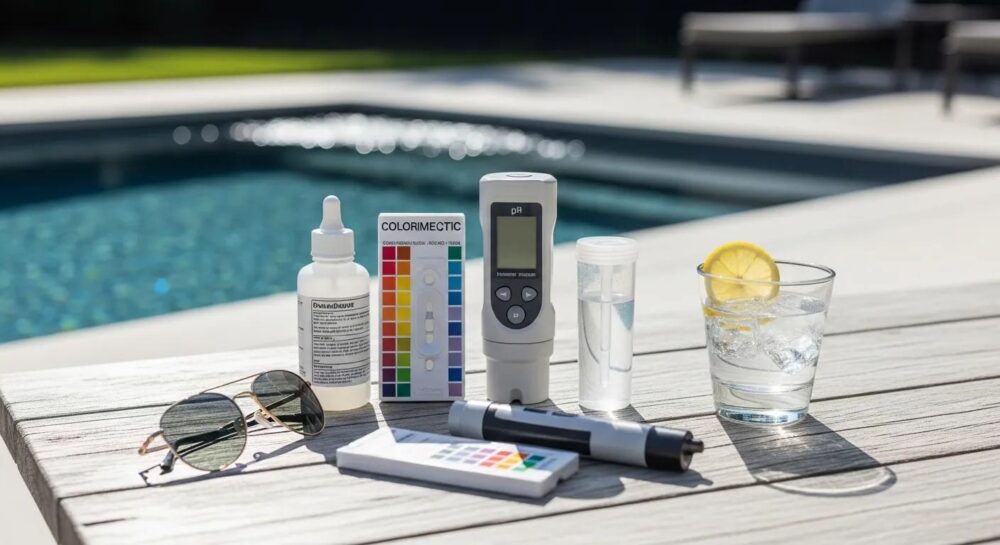
Test Your Pool Water at Home
Keeping your pool balanced and safe starts with regular testing. This guide explains the most reliable home testing methods for Brookfield homeowners, how to use common test kits, and what your results mean. Many pool owners wrestle with problems like algae, cloudy water, or skin irritation because chemical levels drift out of range—simple, consistent testing prevents that. Follow these steps to keep your water clear, comfortable, and ready for swimming.
For a clearer picture of overall pool health, some studies compress multiple measurements into a single water-quality index — a useful way to summarize several indicators at once.
Swimming Pool Water Quality Index & Parameters
This research developed a Swimming Pool Water Quality Index (SPWQI) to quantify pools’ pollution potential. The index provides a consistent, single-value summary of pool water quality, making complex data easier to communicate to the public and decision makers. Using a literature review and the Delphi method, the authors selected 13 key physicochemical and biological parameters, weighted by expert judgment. The study shows it’s possible to calculate one numerical score (SPWQI) that reflects the combined impact of those important parameters on water quality.
An innovative swimming pool water quality index (SPWQI) to monitor and evaluate the pools: design and compilation of computational model, R Nabizadeh, 2019
What Are the Best Pool Water Testing Methods for Homeowners in Brookfield?
Brookfield homeowners have several practical options for testing pool water. Regular checks are the simplest way to prevent problems and keep chemicals in balance. The most common at-home methods are:
- Test Strips: Fast and easy — dip a strip, wait a few seconds, and match the colors to the chart.
- Liquid Test Kits: These use reagents added to a water sample to produce color changes. They’re typically more precise than strips.
- Digital Testers: Electronic meters give precise numeric readings and are great if you prefer straightforward, repeatable results.
Test at least once a week during the swimming season, and test more often after heavy use, storms, or chemical adjustments.
How Do Pool Water Test Kits Work and Which Types Are Available?
Test kits measure the concentrations of key chemicals—pH, chlorine, alkalinity, and more—by producing color changes or numeric readouts. The main kit types are:
- Strip Test Kits: Color-changing strips that react to different chemicals and give immediate, visual results.
- Liquid Test Kits: Reagents are added to measured samples; the resulting colors match to a chart for more accurate readings.
Both work well for routine checks, but liquid kits usually deliver finer detail, which helps when you need exact adjustments.
What Are the Advantages of Using Strip vs. Liquid Test Kits?
Choosing between strips and liquid kits comes down to convenience, accuracy, and budget:
- Ease of Use: Strips are quick and low-effort—ideal for routine spot checks.
- Accuracy: Liquid kits generally give more reliable, precise results for critical adjustments.
- Cost: Strips are often cheaper upfront, making them a good choice for casual maintenance.
Pick the option that fits your schedule and how exact you need your readings to be.
How to Use a Pool Water Test Kit: Step-by-Step Instructions
Testing your pool is simple when you follow the right steps. Here’s a clear routine to get accurate readings:
- Gather Supplies: Have your test kit, a clean sampling container, and a notebook or phone to log readings.
- Collect a Water Sample: Scoop water from about elbow depth, away from returns and skimmers for a representative sample.
- Perform the Test: Follow the kit directions—dip the strip or add reagents—and wait the specified time to read results.
- Record Results: Write down the values and the date so you can track trends and spot recurring issues.
Consistent sampling and recordkeeping make it easier to spot changes and act before problems grow.
What Are the Essential Steps to Accurately Test Pool Water at Home?
Accurate testing depends on timing, cleanliness, and following directions. Use this checklist to get dependable results:
- Choose the Right Time: Test in the morning before swimmers and chemical additions for the most stable readings.
- Use Clean Equipment: Dirty containers or hands can skew results—use only clean tools.
- Follow Instructions Carefully: Exact volumes and wait times matter; follow the kit’s steps precisely.
- Compare Results to Ideal Levels: Use standard target ranges to decide whether you need to adjust chemicals.
These simple practices reduce error and help you maintain a healthy pool.
How to Interpret the Colors and Results from Your Test Kit?
Reading your kit correctly is the key to making useful adjustments. Here’s how to interpret common outputs:
- Color Matching: For strip tests, compare each pad to the chart immediately after the recommended waiting time—lighting can affect how colors look, so check in natural light if possible.
- Understanding Results: Liquid kits produce specific hues tied to concentration ranges—match them to the chart and note the exact value.
- Common Issues: If readings show low chlorine, high pH, or other imbalances, follow adjustment steps to bring levels back into range, then retest.
Accurate interpretation lets you make the right fixes without guessing.
What Are the Ideal Pool Water Chemical Levels and How to Balance Them Safely?
Keeping chemicals within recommended ranges keeps swimmers comfortable and protects your pool equipment. Target levels are:
- Chlorine: 1-3 ppm (parts per million)
- pH: 7.2-7.8
- Alkalinity: 80-120 ppm
- Calcium Hardness: 200-400 ppm
Safe balancing practices include:
- Adding Chemicals: Use pool-specific chemicals to raise or lower pH, alkalinity, and sanitizer levels—follow label instructions and add slowly.
- Regular Testing: Recheck after each adjustment to ensure you’ve reached the target range without overshooting.
- Consulting Professionals: If levels are persistently out of range or the problem is complex, contact a pool service for expert guidance.
Small, measured adjustments and frequent testing are the safest path to a balanced pool.
What Are the Recommended Ranges for Chlorine, pH, Alkalinity, and Hardness?
Here are the standard target ranges to keep your pool comfortable and safe:
| Chemical Level | Recommended Range |
|---|---|
| Chlorine | 1-3 ppm |
| pH | 7.2-7.8 |
| Alkalinity | 80-120 ppm |
| Calcium Hardness | 200-400 ppm |
Staying within these ranges helps prevent algae, corrosion, and swimmer discomfort.
How Do You Adjust Pool Chemicals Based on Test Results?
Follow these common corrections when tests show imbalances:
- Low Chlorine: Add chlorine tablets or liquid chlorine to raise sanitizer levels; follow product dosing for your pool volume.
- High pH: Apply a pH decreaser (sodium bisulfate) in small doses, then retest after circulation.
- Low Alkalinity: Use sodium bicarbonate to boost total alkalinity and stabilize pH.
- High Hardness: If calcium hardness is too high, dilute the pool water with fresh fill water to lower it.
After any chemical change, run the pump, wait the recommended time, and retest before allowing swimming.
How Does Brookfield’s Local Water Quality Impact Pool Water Testing and Maintenance?
Brookfield’s source water can influence how often you test and which chemicals you use. Local minerals and baseline pH affect how quickly levels change after fills or backwashing. Knowing your municipal water’s characteristics helps you anticipate adjustments—if your fill water is hard or slightly alkaline, you’ll likely need different dosing than someone with soft, neutral water.
What Are the Typical Water Hardness and Chemical Characteristics in Brookfield?
Brookfield’s tap water is often moderately hard, typically around 150–250 ppm. That level can increase calcium buildup and change how much chemical you need. The local supply can also trend slightly alkaline (often about 7.5–8.0 pH), which may push your pool’s pH upward over time. Understanding these tendencies makes it easier to keep your pool balanced.
How Should Pool Owners Adapt Testing and Chemical Balancing to Local Conditions?
Adjust your routine to match Brookfield’s water profile and seasonal needs. A few practical tips:
- Seasonal Adjustments: Test more often in summer when bather load and temperatures rise.
- Local Water Quality: Account for tap water hardness and pH when refilling or diluting your pool.
- Regular Maintenance: Schedule periodic professional checks to verify your approach and address long-term trends.
Local awareness makes maintenance predictable and reduces surprise corrections.
How Often Should You Test Your Pool Water and Where to Find Testing Services Near Brookfield?
Regular testing is the foundation of pool care. Test weekly during the swim season and more frequently after storms, heavy use, or chemical changes. If you prefer a professional analysis, several Brookfield-area services and pool stores offer in-depth testing and tailored recommendations.
What Is the Recommended Frequency for Pool Water Testing at Home?
Test at least once a week during the swimming season. Increase frequency after rain, parties, or when adding chemicals. Weekly checks let you catch small trends before they become major problems.
Where Can You Access Professional Pool Water Testing Services Near Brookfield?
Local pool supply stores and service companies provide convenient testing and analysis. They can run tests that go beyond basic kits and offer precise recommendations. For hands-on help, visit our showroom to see testing products and speak with experienced staff.
Keeping your pool balanced takes the right tools and know-how. At Leisure Pool & Spas, we provide services to keep your system running smoothly and water chemistry in range.
Use a reliable pool water test kit for consistent monitoring to avoid surprises.
For dependable advice and quality products, Leisure Pool and Spas is here to help you enjoy a clean, well-maintained pool all season long.
Frequently Asked Questions
What should I do if my pool water test results are out of range?
If a test shows levels outside the recommended range, act promptly: raise low chlorine with chlorine tablets or liquid chlorine; lower high pH with a pH decreaser like sodium bisulfate; raise low alkalinity with sodium bicarbonate; and reduce high calcium hardness by partially draining and refilling with fresh water. After any adjustment, circulate the water, wait the suggested time, and retest to confirm balance.
How can I prevent algae growth in my pool?
Prevent algae by keeping sanitizer and pH within the recommended ranges, brushing the pool surfaces regularly, and maintaining filter performance. Run the pump as needed to keep water moving, clean skimmer and pump baskets, and consider a preventive algaecide during hot months or when algae pressure is high. Consistent testing and routine cleaning are the best defenses.
What are the signs that my pool water is not safe to swim in?
Warning signs include cloudy or green water, unusual odors, visible debris, and test results showing low chlorine or extreme pH. These conditions can irritate skin and eyes or harbor bacteria—do not swim until you’ve tested, treated, and confirmed the water meets safety levels.
How does temperature affect pool water chemistry?
Warmer temperatures speed up chemical reactions, which can deplete chlorine faster and shift pH and alkalinity. Heat also encourages algae growth and reduces sanitizer effectiveness, so check chemical levels more often during hot spells and adjust dosing as needed.
Can I use household chemicals to balance my pool water?
Avoid household chemicals for pool care; they aren’t formulated for pool systems and can create unsafe or unpredictable results. Always use products labeled for pool use—pH adjusters, chlorine formulations, and alkalinity increasers—so you get safe, reliable outcomes.
What should I do if my pool water is green?
Green water usually means algae. Start by testing for chlorine and pH, then shock the pool with a high dose of chlorine to kill algae. Brush surfaces, run the filter continuously, and use an algaecide if needed. Keep testing and filtering until the water clears, then maintain normal sanitizer levels to prevent recurrence.
How can I ensure my pool water remains balanced throughout the season?
Set a regular testing schedule (weekly at minimum), monitor key parameters, and make small adjustments rather than large ones. Keep filters clean, maintain proper circulation, and cover the pool when not in use to limit debris. When in doubt, consult a local pool professional to address persistent issues or perform a comprehensive service.
About the Author
Leisure Pools & Spas is a family-owned business proudly serving the Brookfield community. Owned by Pat Reed, the company is run alongside his wife, Donna, and their son, Andy, combining years of experience and dedication to pool care. To learn more about our story, visit our About Us page and meet the team on our Meet Our Team page.


